Our
Services
Welcome to Robin Hood Electrical Services, an NICEIC and TrustMark- accredited electrician in Nottingham, providing a full range of electrical services for homeowners, landlords and businesses at competitive prices.
Whether you need a simple socket added, a full property rewire or a new EV charging point installed, we are here to help with honest advice, reliable workmanship and all the certifications you need on completion.
From the most straightforward domestic jobs to larger commercial installations, we cover all aspects of electrical work across Nottingham and the surrounding areas. Every job is carried out to the highest standards, in full compliance with current UK wiring regulations and Part P of the Building Regulations.
Finding an electrician in Nottingham you can trust is not always easy. We believe in doing things the right way: turning up when we say we will, explaining clearly what needs to be done and why, and leaving every job neat, safe and properly certificated.
As a NICEIC-accredited contractor, all of our electrical work is carried out to the standards set by one of the UK's leading electrical certification bodies, and every installation is registered and certified on completion.
We are also registered with TrustMark, the government-endorsed quality scheme for tradespeople, giving you additional peace of mind that the work carried out in your home or business meets current safety and quality standards.
Centrally based in Nottingham, we carry out electrical work across the city and the surrounding areas of Nottinghamshire. Whether you are in the city centre, the suburbs or one of the surrounding towns and villages, we are well placed to help.
Areas we regularly cover include (but are not limited to):
In addition to Nottingham, we can undertake electrical work in Mansfield, Derby, Grantham, Leicester and Sheffield.
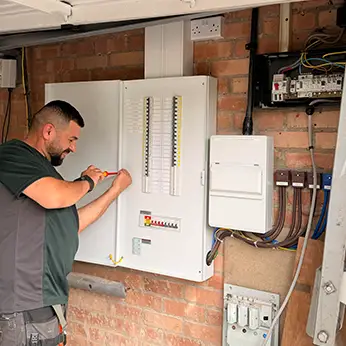
A fuse box is an older term for the unit that protects your home's electrical circuits, typically using rewirable or cartridge fuses that need to be manually replaced when they blow.
A modern consumer unit replaces this with circuit breakers and RCD protection, which trips automatically and can be reset instantly, offering a significantly higher level of safety.
Part P is the section of the UK Building Regulations that governs electrical safety in domestic properties in England.
It requires that notifiable electrical work, including new circuits, consumer unit replacements and work in kitchens and bathrooms, is either carried out by a registered competent person or approved by your local building control authority before work begins.
For larger notifiable works, you should receive an Electrical Installation Certificate (EIC) signed by the electrician who designed, installed and tested the work, along with a Building Regulations Compliance Certificate confirming the work has been registered with the relevant scheme body. For smaller additions such as a new socket on an existing circuit, you should receive a Minor Electrical Installation Works Certificate (MEIWC).
An Electrical Installation Condition Report is a formal inspection and test of the fixed wiring in a property, assessing its safety and condition against the current UK wiring regulations, BS 7671.
The report grades any issues found as C1 (danger present, requires immediate action), C2 (potentially dangerous, requires urgent attention) or C3 (improvement recommended), giving you a clear picture of the safety of your installation.
The timescale for a full rewire depends on the size and age of the property, but as a general guide, a typical three-bedroom house takes between three and five days to complete.
We always aim to work in a planned sequence to minimise disruption, and we will discuss the programme of work with you before we begin so you know what to expect.
Notifiable electrical work that has not been properly certified and registered can invalidate your home insurance in the event of a fire or electrical fault, as insurers may argue the installation did not meet current regulations.
Using a NICEIC-accredited contractor ensures all notifiable work is correctly certified and registered, protecting both your safety and your insurance cover.
A home extension requires a new set of circuits for sockets, lighting and any fixed appliances such as underfloor heating or extractor fans, all run from the consumer unit.
Depending on the number of new circuits required, the consumer unit itself may also need to be upgraded to accommodate them, and all the electrical work must be notified and certified under Part P of the Building Regulations on completion.
Before a home EV charger can be installed, an electrician will assess your main fuse rating, the available capacity in your consumer unit and whether your earthing arrangements are suitable.
Most modern UK homes with a standard 100-amp supply can accommodate a 7kW wallbox charger without major changes, but older properties with a lower-rated supply or an outdated consumer unit may require upgrades before installation can proceed.
Battery-operated smoke alarms rely on the homeowner replacing the battery regularly and can fail silently if the battery runs flat and is not replaced.
Mains-wired alarms are connected to the property's electrical supply with a battery backup, ensuring they remain operational even during a power cut, and interlinked mains-wired systems trigger every alarm in the property simultaneously when any one alarm detects smoke, giving occupants the maximum possible warning time.
If you are looking for a reliable, NICEIC-accredited electrician in Nottingham, we would love to hear from you. Get in touch today and we will provide a free, no-obligation quote for any electrical work you need carrying out, large or small.